Tuesday, September 18, 2018

JRM 2012 New Varieties of Citrus (Tangerines) | Sweet and Hold Up to 60 Days - Indonesia's Natural Wealth
JRM 2012 tangerines are an innovation of Balitjestro (Balitbangtan - Indonesia). This Research and Development of Orange Citrus Varieties Able to Survive up to 60 Days.
JRM 2012 New Varieties of Citrus (Tangerines) - Almost tens of kilograms of oranges were piled up at a supermarket in Malang, East Java Province. However, on the fifth day around 100 kg of oranges were sold out. Consumers invade bright orange, smooth and shiny orange. As soon as the harvest until the fourth day, the orange flavor of JRM-2012 - the name of the new orange - was rather sour.

JRM 2012 Sweet and Hold Up to 60 Days


However, on the fifth day, the orange flavor was sweet. The sweetness level of fruit on the fifth day postpartum reaches 14 ° briks. That is why the supermarket is asking for JRM-2012's orange supply back. Many consumers are indeed looking for JRM-2012 oranges. In addition to sweet, medium-sized tangerine-weight of an average of 120 grams per fruit-it is also durable. The oranges can survive 60 days at room temperature. Because, the pores of JRM fruit skin are relatively tight and the skin of the fruit is quite thick.
JRM-2012 new oranges are sweet up to 140 briks and hold two months.

Australia

Two months after storage showed that the fruit condition was still good, the color of the reddish orange flesh, the skin remained smooth, and was still suitable for consumption. Because it can last 60 days, of course it can suppress price fluctuations. Another plus, the fruit epidermis is very soft so it can be swallowed with fruit flesh. Besides that, there are apitan fruit, later fruit after a big harvest. Production of 2.5-year-old trees averages 15-20 kg per tree. Unfortunately, supply is still limited. JRM's orange supply came from 30 orange trees JRM-2012 collection of Citrus and Subtropical Research Institute (Balitjestro) in Batu City, East Java Province.

JRM 2012 New Varieties of Citrus

this girl poses on the new JRM-2012 Orange tree whose fruit is still young.

The name JRM actually refers to Jestro, the name of the institution stands for orange and subtropical plants. As for the letter M mandarin acronym, the international term for tangerines. However, JRM-2012 was not from Mandarin, but from Australia. Growers in Queensland, Australia, developed it because it is of high commercial value because of its large size, attractive colors and stable quality. Economic potential is also one of the benefits of JRM orange that supports national fruit production.

Planters can plant JRM-2012 citrus with a population of 400 plants per ha and produce fruit first at the age of 2.5 years, which is 20 kg per tree. With a selling price of Rp 7,500 per kilogram alone, the farmer's turnover is Rp 60 million per year. The income doubled with age.

In fact, JRM prices in supermarkets reached Rp. 15,000 per kg. While the selling price of other oranges was only Rp 10,000 per kg. With these various advantages, the government finally released JRM into a national superior variety in 2014 in accordance with the Decree of the Minister of Agriculture of the Republic of Indonesia number 040 / Kpts / SR.1201D.2.7 / 6/2014. JRM oranges are suitable for consumers in Indonesia who like sweet oranges.

Almost all consumers of tangerines in Indonesia like sweetness. However, some of the upper middle class people want high vitamin C so that the sweet taste of JRM varieties is the right choice. The Research Institute for Citrus and Subtropical Plants, Arry Supriyanto, brought the varieties of entres in 1987. He then planted them in pots in the screen house of the Punten experimental garden, Batu City, East Java.

Cultivation

JRM-2012 collection at Tlekung Experimental Garden, Agricultural Research and Development Agency.

Oranges require special environmental conditions to produce maximum. Climate (temperature, sunlight, rainfall) and soil physical properties are environmental factors that are very difficult to control. However, in general JRM-2012 grew well in areas with temperatures of 22-300C. In Indonesia, the condition is located in a mediumland up to 1,100 meters above sea level. The new variety is suitable to be planted in dry climates until wet, optimum rainfall is 1,500-2,500 mm per year with dry months (less than 60 mm) 3-4 months in a row.

The 5-8-hectare soil is suitable for cultivating JRM-2012 citrus. The newcomer grew up on dry or wet land. The ideal groundwater level is 75% to meet the needs in the critical period, namely new growth, flowering, and fertilization. It is better to use the seedlings produced by the grafting or grafting propagation. JRM-2012 variety of grape buds (entres) in the JC stem-stem aged 6-8 months (ready for oculate. Grafting seedlings ready for planting at 4-5 months. Plant spacing of 4 mx 4 m or 3.5 mx 4 m depending on fertility soil.

The planting hole is 60 cm x 60 cm x 60 cm. Cultivating on rocky soil, digging must be deeper. Balitjestro recommends the use of plastic mulch to prevent weeds that interfere with the availability of nutrients for plants. The right time to plant JRM-2012 citrus seeds at the beginning of the rainy season November-December. Moreover, planting on dry land with limited water availability.
Display of JRM 2012 citrus (tangerine fruit).

Planting can also be towards the end of the rainy season. The condition is that the planters must be ready to water so that the plant growth is not disturbed The roots of young plants only 50 cm have not been able to utilize water in the deeper layers of the soil, especially in the dry season. Therefore sufficient and regular irrigation during the dry season is very important to help growth and prevent the death of young plants.

Meanwhile water management in adult plants to regulate flowering needs to reduce water (stress) until the leaves roll and then fertilized and watered, so naturally the plants simultaneously flower and bear fruit. JRM-2012 oranges need balanced nutrition to produce optimal production. The new variety starts to bear fruit at the age of 2-2.5 years. Sometimes fruiting ages go back 0.5-1 years due to plants prioritizing vegetative growth. That's usually because plants get enough fertilizer and groundwater conditions are guaranteed. The fruit is ready to harvest when it is 6-7 months after the flower blooms.
The physical appearance of JRM 2012 is similar to mandarin oranges.

Farmers in Batu and Malang City also cultivate oranges in pots or drums. They take care of the plants to bear fruit so that they are more dirty. With excellent appearance, farmers are easy to sell orange trees planted in pots. JRM 2012 also has the potential to be planted in pots because it has open branches so it is more beautiful. Until now Balitjestro-limited production of seeds to get feedback from farmers and prevent the spread of uncontrolled seedlings. (Emi Budiyati, researcher at the Research Institute for Citrus and Subtropical Fruits, Agency for Agricultural Research and Development).

Source :
balitjestro.litbang.pertanian.go.id 
Thursday, August 23, 2018

Water guava fruit with the name Dhegus | Indonesian Fruits
Water guava fruit with the name Dhegus  Indonesian Fruits

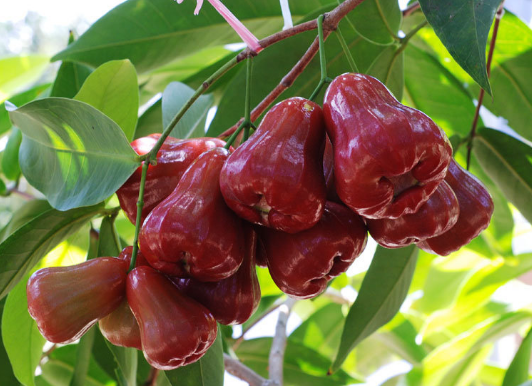
Water guava fruit with the name Dhegus - "The beauty of the guava is Degus, short for Gede(big) and Bagus(nice), as the name implies the appearance of the guava fruit is quite large with an attractive dark red fruit skin color, sweet and crispy flavor coupled with thick fruit flesh and a tambourized fruit shape similar to , an appearance that has a beautiful impression is the advantage of the beautiful Guava Degus. "

Degus guava is the name given by Mr. Ir. Soedarmo, former Bojonegoro District Agricultural Extension, and he was known by the nickname Mbah Darmo because he was a senior Agricultural Extension in East Java, most recently as East Java Agriculture Extension Coordinator. He was the first to spread this guava plant in East Java, including several locations around the Pohjentrek Pasuruan Seed Horticultural Motherhouse, which was then one of those planted at the Horticulture BBI was selected as the Mother Tree and was released by the Minister of Agriculture in 2006 with Decree No .339 / KPTS / SR.120 / 5/2006.

Water guava fruit with the name Dhegus | Indonesian Fruits


Water guava fruit with the name Dhegus  Indonesian Fruits

Degus guava can grow anywhere, from the lowlands to an altitude of 1000 m above sea level, but ideally to be able to produce optimally should be planted in low land with a height of not more than 400 m above sea level. With low rainfall of 500-1000 mm / year with a number of rainy days of 50-70 days / year or dry areas with a dry season of more than 4 months.

This juice can be cultivated either in pots or called Tabulapot, planted in the yard or tabulakar and also on a large scale which requires a special area for business success, for this reason it is necessary to consider the nature and conditions of growth and infrastructure available in the planting location.

1. Propagation of seeds / seeds

Propagation of degus water guava can be done by grafting, connecting, grafting and seeding. The choice of propagation method is adjusted to the requirements, the time conditions for the costs and the available technical personnel. Seed propagation is quite successful and the most appropriate is by grafting and grafting from the parent tree. For seed multiplication, it is produced by seed producers who have been registered at the Seed Certification and Monitoring Center (BPSB) with labeled seed production.

2. Planting

The spacing of the planting of degus water guava planted in the garden widely, the spacing between trees is at least 5 x 5 m. With this spacing, then in 1 hectare it takes 400 seeds plus 10% as a substitute for seeds that may not grow or die.

- Preparation of planting holes

Planting holes should be prepared as much as possible 2 weeks before planting. The hole is made by means of the soil excavated with a size of 60x60x60 cm. The upper part of the soil (30 cm thick) is separated from the bottom soil, within 2 weeks, the hole is left to the sun.

- Planting

When planting seeds. holes filled with sand 2/6 parts, 3/6 parts filled with fertile soil / top soil excavation after clearing of grass seeds, then the seeds are planted after the plastic packaging has been removed, the top layer is given manure as a basic fertilizer 1/6 parts (+ 10 kg).

3. Maintenance

- Sprinkling

If there is no rain for 2 weeks after planting it needs to be watered twice a day, the rest is only once a day. After the plants grow, watering is no longer needed because the roots of the plants have penetrated the soil far enough to get enough water even though the surface of the soil seems dry, on the contrary to avoid excess water, during the rainy season, plants need to be drained around it.

- Weeding

Weeding is done with the aim of removing bully plants (weeds), wild grasses and vines that often grow around plants can interfere with growth, especially when the plants are still small, aged 1- 3 years. When cleaning weeds, it can also be done weeding around the plants at least twice a year weeding and roasting.

- Advanced Fertilizer Giving

Fertilization is the right choice so that the degus water guava plant can produce better. Provision of artificial fertilizer is carried out twice a year and manure is given once a year, before the dry season of the dry season. Fertilizer dosage is adjusted to the age of the plant.

- Stitching

Seedlings that do not grow or die must be immediately refined, namely replacing dead seeds with new ones. Late embroidering will make plants grow not as big.

- Trimming

Maintenance pruning is done on branches, branches and twigs that are dry, dead, wounded, old, broken, and other parts of plants that are not perfectly growth. Pruning is also done on branches that overlap, growing irregularly so that the main branch is defeated. Branches that are sick or old but still productive enough are not cut out, but are left about 5 cm from the base. Crops that are too dense are also trimmed to avoid fungus coming.

4. Pest Control Disease

From the inventory of pests and diseases that attack degus water guava, there are several types of attacks that need attention. Symptoms of attack from each type are as follows:

Atlas moth (Attacus atlas)

The caterpillars are very greedy for eating leaves. Control by collecting eggs, caterpillars and cocoons to be destroyed and spray contact insecticides.

- Soft green scale (Coccus viridis (Green))

Causes of black fungus such as soot. Control of natural ways is eaten by several kinds of ladybugs. These fleas in the rainy season can be destroyed by fungus attacks, chemical control using contact insecticides.

- Bactrocera (Bactrocera sp.)

The genus name is derived from Ancient Greek bakter "rod" and kera "horn". This fly puts the eggs in the flesh, so after hatching the larvae eat the degus guava fruit. The use of Methyl eugenol and hydrolizate protein combined with insecticides.

- Root and Fruit Fungus

The rot in the root is caused by water flooding that is too long, causing rotting to the roots. The rot on this fruit is due to pest bite so that the fungus causes the fruit to fall out and rot. Control by improving soil aeration and fruit wrapping, as well as spraying insecticides and fungicides such as thiodan and dithane.

Cultivation of Dhegus guava can also be done by:


Water guava fruit with the name Dhegus  Indonesian Fruits

1. Cultivation of fruit plants in pots

Cultivation of fruit plants in pots or more popularly called tabulapot is basically planting fruit trees using pot plant media. The stages that need to be known:

  • Bibit is taken from the polybag packaging / media carefully so as not to damage the roots, so that the plants do not die.
  • Bibits are placed in the center of the hole as deep as the root neck. If you plant too much, the body will be less good.
  • Before being planted, the leaves are cut in half to reduce evaporation of water because the roots cannot absorb enough water from the soil.


Certain recipes to optimize the guava juice of Degus water include:
  • A suitable and optimal pot size used is usually 30-70 cm in diameter with a height of 40-50 cm.
  • Media planting a mixture of soil, sand, and manure 1: 1: 1 ratio.
  • First fertilization 1: 4: 2 Urea, SP36, and NPK 50 gr perpot at 2-3 months old, repeated every 3 months.
  • Flowering stimulation using ZPT such as Atonik.


Tabulapot guava, Degus water, besides being able to provide vitamins or fruit for the family, this tabulapot also has more value on its figure, red fruit clustered together with ornamental plants in the yard will look beautiful to look at.

Water guava fruit with the name Dhegus  Indonesian Fruits

2. Cultivation of fruit plants in the yard

In principle, the cultivation of fruit plants in the yard is the same as the treatment and technical planting, but there are certain things to note, namely:

  • The location or location of planting must be considered.
  • Lighting continuity is not interrupted.
  • Not disturbing or covering the building nearby.
  • Plant maintenance is expected to need consistent attention, do not let the plants become shrubs once.
  • Fertilization is done by using manure and artificial fertilizers such as urea, TSP, KCL. Every year the dose is added.

Water guava fruit with the name Dhegus  Indonesian Fruits

The method of planting in this yard does require a small yard which is eligible for shrubs. The production of guava Degus in this yard is more than the tabulapot. This is indeed expected for the needs of family fruits, as well as additional income when sold.


source:
bbppketindan.bppsdmp.pertanian.go.id

Saturday, August 18, 2018

How to plant longan fruit - so that it can bear fruit quickly
How to plant longan fruit so that it can bear fruit quickly

How to Plant Longan Fruit- The following article contains a guide on how to plant a good longan and tips for success for those of you who want to cultivate longan. Longan fruit is very popular with many people because the taste of this fruit is very sweet and fresh. This fruit flavor is very similar to the taste of lychee fruit. It's just the texture and color of the skin that distinguishes. In addition to its delicious taste, this longan fruit turns out to contain many health benefits for the human body because the content in fruits such as vitamin C and various essential minerals. Some of the benefits of longan fruit include:
  • Source of Vitamin C
  • Strengthens bones
  • Keep eye health
  • Help with diet programs
  • As a source of energy
  • Heal wounds
  • Reduce stress

Now, after knowing a lot of the benefits as above, the market demand for longan fruit is also high especially in urban areas. Therefore, now longan plants are widely cultivated for sale to get profit. Hearing the potential of this longan fruit you might also be interested in participating in cultivating it.

You need to know that to plant these longan trees you do not need large maintenance costs as to how to grow melons and are not as complicated as how to grow chilies. Even planting in the yard of the house can and you can use it as a shady tree as if you know how to plant mango or how to plant guava in your home garden.

Before you start cultivating longan plants, all you need to know is how to plant the right longan. This is so that you do not experience confusion and can get optimal benefits. For those of you who are interested in trying to cultivate longan, here we provide information about how to plant the longan longan to serve as your guide in cultivating longan.

How to plant longan fruit so that it can bear fruit quickly


How to plant longan fruit so that it can bear fruit quickly
Origin Of Passion Fruit | Benefits for health

The steps of planting longan are as follows:

 01  Land Preparation

Longan fruit can actually live in the lowlands and highlands. A good planting area for longan plants must meet the following criteria:
  • Exposure to direct sunlight at least 7 hours a day
  • Soil contains enough nutrients
  • Close to water sources for watering
  • The level of soil acidity (pH) is between 5.5 - 7.5
  • Somewhat far from the beach so the plants are not exposed to the fog of salt water from the sea.
Benefits of Lime for Health, Face and Hair

If you have found a land that meets the above criteria then immediately do preparations such as weeding and pruning branches that block sunlight. Then you can make planting holes.

 02  Planting Hole Making

The next way to plant longan is to make planting holes. If you plant a lot of longan trees, then the planting holes should be neatly arranged to facilitate the process of fruit care and harvest later. Use a hoe and dig a hole with a size of 50 x 50 cm with a depth of 40-50 cm. This hole will need to be filled with basic fertilizer before planting.

 03  Giving Basic Fertilizer

For basic fertilizer this longan plant uses organic fertilizer and additional NPK + Kapur Dulomit. The best organic fertilizer for longan plants is manure. This manure needs to be completely decomposed by microorganisms to be ready to be absorbed by plants. To decompose the fertilizer, we need EM4 (Effective Microorganism) which is widely sold in agricultural stores. The way to apply EM4 to fertilizer is as follows:
  • Dissolve 1/4 kg of sugar (sugar, brown sugar, juice or sugar cane) in 1 bucket of water
  • Pour EM4 in the sugar solution
  • Close and let stand at least 24 hours (the longer the better). This is to increase the number of microorganisms
  • Mix manure + NPK + Dulomit with a ratio of 30: 1: 2 then stir evenly
  • Put the fertilizer in a hole and flush with water
  • Purse the EM4 solution that has been prepared beforehand and then cover the hole with the soil.


Leave at least 2 weeks so the fertilizer decomposes first. Avoid using fertilizer that is still new to the plant because the temperature in the soil will increase when fertilizer is being decomposed which in turn can eventually kill the roots of the plant.

 04  Preparation of Longan Seeds

Longan can be seeded through seeds or through grafts. Each has advantages and disadvantages. The following is an explanation of how to seed a longan.

Longan Nursery Using Generative Ways

The steps are as follows:

  • Make sure to choose longan seeds from superior seeds, which are already large, dense fruit and healthy (not sick)
  • Get the seeds from ripe fruit even almost rotten, wash the seeds and dry in the sun for 1 hour
  • The contents of a large black polybag plastic with a mixture of humus soil, husks and sawdust so that the soil remains loose
  • Water the soil in a polybag to get wet (just a little)
  • Plant longan seeds only 1 - 2 cm deep and place them in the shade
  • Wait until the seeds grow
  • After growing, do regular watering until the plant height is approximately 15 cm, it can be moved to a place exposed to direct sunlight for only 3 hours per day.
  • After the seedling height is around 30-50 cm, the aunt is ready to be planted into the planting hole.
Advantages of Pomegranate

Advantages :
+ Plant life is longer
+ Plants are more resistant to pest attacks
+ The burning of plants is stronger
+ Production of fruit can outperform broodstock

Deficiency :
- The time of the nursery is rather long
- The first harvest time is also a bit long
- The plants will grow tall and big, making it difficult to harvest the fruit
- Maintenance costs from nurseries to harvesting more

Longan Nursery How to Vegetative Grafts

How to plant longan fruit - so that it can bear fruit quickly

The steps are as follows:
- Choose a plant that has thick and healthy fruit and then look for stems that are straight and about 3 cm in diameter
- Peel the skin of the base of the stem that you want to graft and then clean it from the mucus until it's not slippery anymore
- Use plastic or coconut fibers as a wrapper.
- Tie it to the base under the peeled part
- Fill with wet humus soil then pinch the top end of the wrapper and tie the graft bud
- Consider the graft and diligently watered. Usually the roots will come out in the second or third week.

Cempedak | Benefits For Better Life

After the roots are felt long enough, then cut the bottom of the graft and then plant it into the planting hole that has been prepared.

Advantages :
+ The nursery time is relatively short
+ The first harvest time is also short
+ The trees will not grow tall so they are easily harvested
+ The costs incurred during the nursery to harvest less

Deficiency :
- The plant life is not long (according to the remaining age of the brood tree)
- Can not be used as a shady tree (yard shade)
- Less resistant to disease
- Plant roots are not strong
- Production of fruit will not exceed the broodstock and even tend to be less

Now after knowing the advantages and disadvantages of each nursery method, you can choose which method you want to use yourself.

 05  Planting of seeds at planting holes

The steps for transferring seeds to the planting hole are as follows:
  • Water seedlings before being moved
  • Infuse of insecticides and fungicides in the planting hole before planting
  • Do the transfer in the afternoon to avoid wilting during the day
  • Immediately flush the plant that has been planted and then do the planting for the first 2 weeks
  • Continue replanting after the first 2 weeks then continue at the treatment stage of longan plants.
  • Care the seeds that have been moved.

 06  Care for Planting

This is an important part of how to plant longan because it will affect plant growth. Treatment of longan plants that need to be done so that plants thrive.

 07  Supplementary Fertilization

Use NPK solution and mix the liquid organic fertilizer that is leaked at the base of the plant. Dissolve 1 cup of NPK with 35 L of water then add about 40 ml of liquid organic fertilizer to pour. Repeat every 2-3 weeks. Do not pour NPK and urea fertilizer during the rainy season because rainwater already contains a lot of nitrogen.

 08  Watering

Watering is done once a week in the dry season to keep the water level in the soil.

 09  Deforestation of the Land Around the Tree Base

Hoe the soil around the base of the tree and collect it to form a mound around the plant. The point is that water quickly absorbs and does not stagnate, especially in the rainy season.

 10  Basic Re-fertilization

Add the basic fertilizer every 8 - 12 months to maintain the supply of basic nutrients.

 11  Pest and Disease Management

Although classified as pest resistant, but the pest attack certainly can reduce productivity and the quality of harvesting longan plants. In general, attacking pests can be classified into several groups.

 12  Harvest longan

Longan fruit can be harvested at the age of 2 years after planting and for the transplanted one can be faster. From the time of flower to ripe fruit it usually takes about 2 months. How to harvest it is picked by hand or pole if it is too high. Make sure to pick the ripe kelengkles, which are the following characteristics:
  • The color of the fruit becomes brownish yellow
  • The fragrance of the fruit has smelled good
  • The fruit structure is soft if pressed
  • There is no connection that grows in bunches
  • Fruit and away start to duck down
  • You can also pick one then taste the fruit from the bunch. If it feels sweet and smells good, all bunches can be picked.

 13  Post Harvest Treatment

In order for the longan tree to remain productive, then do not forget to do additional treatment after the plant is harvested. What needs to be done is almost the same as treatment, namely by providing supplementary fertilizer, only this time the level is somewhat increased. Basic fertilizers also need to be added so that the plant's nutritional supply is maintained until the next harvest.


Types of Pests in Longan Tree


How to plant longan fruit so that it can bear fruit quickly
Otaheite Gooseberry | Cermai Benefits For Better Life

When you want to find out how to plant longan, you also need to know the types of pests in longan and how to overcome them.
  1. Insects - Pests such as fruit suckers, caterpillars, fruit flies, and stem winches are groups of insects. To control it you can use insecticide type pesticides by spraying.
  2. Mushrooms - Fungal pests attack the roots, which causes fusarium wilt. The most common thing is in the rainy season. The symptoms are the leaves of the plant look wilted and eventually die. Before dying, then immediately fungicide in the root of the affected plant. It is important that the water does not pool around the plant roots.
  3. Bat - This bat is very detrimental when attacking in large quantities because in addition to eating and damaging old fruit he also knocked out young fruit. To overcome the bat attack, you can install the network around the tree and your land area. Bats will get caught in nets so you can catch them.


Success Tips for Longan Cultivation to Make the Harvest Abundant


How to plant longan fruit so that it can bear fruit quickly

Once you know how to plant longan well, then we will also provide tips for you so that the yield of your longan is more and more abundant. Here are tips for planting longan:
  • Use 16-16-16 NPK because there is more macron content than NPK 15-15-15
  • Spray ZPT auxin when the longan tree starts flowering. This will add to the number of flowers that come out so that the fruit will also be more
  • Spray gutelic acid ZPT on the fruit that is still small so that later the fruit size is much larger so that it is heavier when weighed.
  • Pack the KNO3 to the roots of the plant approximately 2 weeks before harvest. This will add to the sweetness and soft texture of the longan fruit.
Such is the information about how to plant a good longan along with successful tips on cultivating longan as a guide for planting for you. We hope that after you understand how to plant the longan well you can cultivate longan with optimal results and benefits.

Friday, August 10, 2018

Land Preparation for Banana Cultivation - Part I || Banana Cultivation
Land Preparation for Banana Cultivation - Part I

Land Preparation for Banana Cultivation - Part I || Surely you are already familiar with this one plant, bananas have become a favorite food of the people today. There are so many types of banana varieties such as Ambon banana, Kepok banana, mas banana, plantain, jackfruit banana, horn banana, and so on. Banana cultivation promises bright prospects. Banana (Musa sp.) Is a very popular tropical plant. The fruit is popular and has been sent to various parts of the world.

Indonesia has a high diversity of bananas. There are at least 10 varieties of superior bananas that flood local and export markets. If you want to know more about the benefits of bananas for health you can visit our article about the benefits of bananas for health. Okay, we just discussed further how to cultivate banana plants so that the abundant harvest.

   I     PRACTICAL STEPS FOR BANANA CULTIVATION


Land Preparation for Banana Cultivation - Part I

  A.   Requirements for Growing Banana Plants

  1.   Climate
  • Banana plants are suitable for areas with tropical climates with high air humidity and quite hot weather conditions. But if the condition of your land is in subtropical or mountainous areas, it doesn't matter because banana plants can adapt to cold enough weather. This plant can survive in areas that lack water, because bananas can supply water from stems that have high water content, but consequently their growth is not optimal.
  • Note also with wind speed conditions at the location of your land because if the wind speed on your land is high enough to damage banana leaves and affect plant growth.
  • Rainfall conditions that are good for banana cultivation are in the range of 1520-3800 mm per one-time growth, with the assumption that in one planting period there are 2 months not rain. try to cultivate bananas to make mounds so that there is no puddle.
  • Bananas are typical of tropical plants. It grows well from the lowlands to an altitude of 1300 meters above sea level. The desired rainfall of this plant is around 1500 to 2500 mm per year with a temperature of 15-35 ° C.
  • Banana plants can grow on almost all types of soil. But the most suitable type of soil is clay-like, alluvial, high in calcium and organic matter.
Land Preparation for Banana Cultivation - Part I

  2.   Banana Planting Media
  • Banana plants can grow optimally in soil conditions that are rich in nutrients and have heavy lime or soil content. This plant has greediness for food, so you need to prepare land that has high nutrients. You can do fertilization to increase soil nutrients by using compost and manure.
  • Banana plants should get intensive irrigation, but try not to have puddles in the land.
  • Note also with the condition of the ground water level, for in the wet area is 50-200 cm, while the half wet area is 100-200 cm, and in the dry area is 50-150 cm. The location of erosion-affected land will not produce good bananas and this plant cannot live optimally on soil that has a 0.07% salt content.

Land Preparation for Banana Cultivation - Part I


Read more:


  3.   Place Height
  • The height at which banana plants can grow in the lowlands to the highlands with altitude above sea level. Whereas for Ambonese banana, horn banana, and jackfruit banana can grow well at an altitude of 1000m above sea level (asl).
Land Preparation for Banana Cultivation - Part I

  B.   Stages of Banana Cultivation

Land Preparation for Banana Cultivation - Part I || Seedlings have an important role in banana cultivation. To get maximum results always use seeds that are free of disease. If you can get superior varieties of seeds from a trusted institution. There are 3 types of seeds for banana cultivation, namely in the form of tillers, weevils and tissue culture results.
  • Seedlings are seeds taken from banana plants that already have shoots or children. The child is separated from a mature and healthy banana plant.
  • The weevil seeds are obtained from the harvested banana plant. Then the plant is dismantled and taken out of the hump (bottom base). The weevil is cleaned, because it is breathed without damaging the shoots. Then split again about the size of buds, or about 10x10x10 cm. Then weeds are planted in the planting medium. Seedlings from weevils are ready to be used for banana cultivation after growing 3-4 months.
  • Tissue culture is a technology to multiply plants carried out in the laboratory. Seeds from this tissue culture are usually free of all diseases and can be held in large quantities. Seed size is also uniform so the harvest time setting is easier to do.
Land Preparation for Banana Cultivation - Part I

  1.   Selection of Banana Seeds

Propagation of banana plants using vegetative methods, breeding process through buds or banana children. Following are the requirements for banana plant nurseries:
  • The condition of a good banana plant seeds has a length of 1-1.5 meters with a diameter of about 15-20 cm. We recommend that you use seeds that come from healthy and fruitful banana brooders. The height of banana seedlings can affect the productivity of bananas in fruiting (a significant effect on the number of combs in each bunch).
  • There are two types of banana plant nurseries namely young puppies and adult puppies. You should use adult puppies because they usually have a flower and food reserves in a banana hump.
  • We recommend that you choose seeds that have a pointed shape like a sword, with narrow leaves from you using broad-leaved banana seeds.

  2.   Seed Preparation

You can get banana seeds by buying at an agricultural nursery shop or using banana seeds from your own garden. Use a spacing of 2 × 2 meters for banana cultivation. If you use your own broodstock, it is better to limit the number of seedlings around 7-9 in brood bananas, if more than 9 shoots should be cut to maintain the quality of seedlings.
Land Preparation for Banana Cultivation - Part I
Before your seeds are planted, you should first do sanitation to avoid the spread of pests and diseases. The following are sanitation steps for banana seeds:
  • After the seedlings are cut from the brood, immediately clean the soil attached to the roots
  • It is best to keep the seeds 1-2 days in a shady location so that the wound after cutting dries, the banana leaves are wide
  • Taking immersion on the stem neck-limited seedlings using insecticides 0.5-1 percent within 10 minutes. Then the seeds are aerated briefly
  • If you don't have insecticides it doesn't matter, you can use running water to soak the seed bulbs for 2 days.
  • If you have a nematode pest in your field, you should first soak it in hot water for a few minutes to kill the pest.
Land Preparation for Banana Cultivation - Part I

  3.   Preparation of Banana Cultivation Land
  • Make sure the land to be used as a place for banana cultivation is free from Fusarium and Pseudomonas disease. If previously the area had been infected by the disease, properly control pests and diseases.
  • Clean the land from weeds, hoes or plows of soil with a depth of 30-40 cm. Make longitudinal beds according to the contour of the land. The distance between beds is adjusted according to the spacing.
  • The planting distance of banana cultivation depends on the variety of bananas. For example for barangan bananas about 3 × 3 meters. With a maximum population of 1000 clumps of plants per hectare. Every 50 meters distance ditches for 1 meter deep drainage channels.
  • Then leave the land for 2-5 weeks.
Land Preparation for Banana Cultivation - Part I

  4.   Banana Planting Process
  • Determination of plant patterns
You can use intercropping patterns in the first 3 months, because banana plants have a fairly wide spacing. Type of intercropping plants that you can mate with banana plants, namely vegetables or seasonal crops.
Land Preparation for Banana Cultivation - Part I
  • Planting hole making
The recommended hole size is 50x50x50 cm for heavy soil types and 30x30x30 or 40x40x40 cm for loose soil types. Use a spacing of 3.3 x 3.3 meters.
  • How to plant
You should start planting bananas in September-October or before the rainy season. Before planting bananas you should give organic fertilizer such as manure or compost in each planting hole as much as 15-20 kg. Organic fertilizers that you give greatly affect the quality of the taste of bananas.
Land Preparation for Banana Cultivation - Part I

  5.   Maintenance of Banana Plants
  • Thinning
In order to obtain a good crop, it is recommended that one banana clump has 3-4 stems. Cut the shoots / tillers regularly so that in one clump there are various kinds of tillers that have different ages (growth phase). After reaching the age of 5 years, dismantle the clump to replace the new banana plant.
  • Weeding
Clean weeds and grasses that can interfere with the growth of the parent and banana saplings. Do the weeding process during the time so that the roots and shoots of the banana can increase. Banana roots have a length of about 15cm below the surface of the soil, therefore we should not need to do the weeding process inside.
  • Packing
Banana leaves that have begun to dry are immediately trimmed to maintain cleanliness and prevent the spread of pests. You can do female activities at any time.
  • Fertilization
Banana plants really need a large amount of potassium in the soil. In 1 hectare of land, it takes 207 kilograms of urea, 138 kilograms of super phosphate, 608 kilograms of KCl, and 200 kilograms of limestone as the main source of calcium. N Fertilizer (Nitrogen) is given routinely 2 times a year where the laying is in a run around the clump of banana plants. After fertilization, the runner sprinkled with fertilizer is then covered with soil. Whereas for potassium and phosphate fertilizer is carried out 6 months after planting (2 times in one year).
  • Watering
Banana plants can grow well if the irrigation is maintained. The method of irrigation can be watered or drained between the lines of banana plants.
  • Fruit maintenance
Land Preparation for Banana Cultivation - Part I || Banana Cultivation - If the banana's heart is 25 cm away from the last banana comb, the cutting process must be carried out so that the growth of the banana is not disturbed. If the fruit combs have expanded perfectly, banana bunches should be wrapped using clear plastic bags to maintain the smoothness of the fruit to avoid pest damage. Use polyethylene plastic bags (can be purchased in plastic stores) 0.5 mm thick and then given a hole with a diameter of 1.25 cm. Arrange in such a way that the plastic can cover 15-45 cm above the top of the comb and 25 cm below the top of the bottom comb.
Watering and Watering

  6.   Banana Plant Diseases and Weeds

  a.   Banana Pests
  • Leaf caterpillar (Erienota thrax.)
The part of the banana that is attacked is the leaf.
- Attack symptoms: the leaves roll like a chimney and tear up the leaves.
- Control methods: using a suitable insecticide is not yet available, you can try using Malathion insecticide.
  • Real beetle (Cosmopolites sordidus)
The part of the banana that is attacked is the petals, stems.
- Symptoms of attack: the halls up or down in the petals, the stem of a banana plant full of aisles.
- Control method: sanitation on a banana clump, immediately clean the clumps from the remnants of banana stems, use sanitary seeds.
  • Nematodes (Rotulenchus similis, Radopholus similis)
The part of the banana that is attacked is the root.
- Attack symptoms: banana plants look miserable, small cavities or spots are found on the roots, swollen roots.
- Control method: use sanitary seeds, multiply soil humus content and use land with small clay content.

Watering and Watering

  b.   Banana Disease
  • Blood disease
Cause: Xanthomonas celebensis (bacteria).
The part of the banana that is attacked is the inner banana plant tissue
- Attack symptoms: banana tissue becomes reddish as it bleeds
- Control: unloading and burning sick banana plants
  • Panama
Causes: Attack of Fusarium oxysporum Fungus
The part of the banana that is attacked is the leaf
- Attack symptoms: leaves wither then break, first attack on the outer leaves and then the inner leaves, banana leaf midrib splitting longitudinally, will remove black sap vessels.
- Control method: unload and burn sick sick banana plants
  • Leaf leaves
Cause: Fungus Cercospora musae.
Parts of bananas that are attacked are leaves that appear brown spots that are more widespread.
- How to Control: use a fungicide that contains Copper oxide or Bordeaux Porridge (BB).
  • Way
Cause: Bacillus bacteria
The part of the banana that is attacked is the root.
- Attack symptoms: plants wither and die.
- Control method: unload and burn sick sick banana plants
  • Leaves
Cause: viral infection through intermediary aphids Pentalonia nigronervosa
The parts of bananas that are attacked are shoots.
- Attack symptoms: banana leaf leaves grow upright in groups
- Control methods: unload and burn sick sick banana plants
Watering and Watering

  c.   Weed on Bananas

Usually shortly after planting bananas and when the adult canopy has begun to form, weeds become one of the problems that must be addressed immediately. The method of control is as follows:
  • Use herbicides such as Gesapax 80 Wp, Round up, Paraquat and Dalapon.
  • Plant ground cover crops that can withstand erosion, are resistant to shade, are not easily attacked by pests, not propagating plants. For example, Geophila repens.
  • Cover the ground using polyethylene plastic.
Watering and Watering


  6.   Harvesting Banana Fruit

The age of harvesting bananas actually depends on the purpose of the market or distribution. For the purpose of exporting fruit must be harvested faster. However, in general, bananas are harvested at 3/4 maturity level for export markets, and for local markets can be harvested at full maturity level. Or, when viewed from the age of bananas can be harvested about 3-4 months calculated from the flower blooms. The characteristics of the fruit are ready to be harvested rounded shape, there is no sharp angle fold. Flowers found on the end of the fruit have dried up and are easily broken. The skin color changes from dark green to light green and the flag leaves on the plant have dried up. When checked in a laboratory, harvested bananas have a starch content of 19.5-20% and a sugar content of 0.5-1%.
Land Preparation for Banana Cultivation - Part I

Land Preparation for Banana Cultivation - Part I || Banana Cultivation - Things to keep in mind, do not let pisnag fall when harvested. Banana tree cutting is approximately two thirds of the land. Drain the sap that drips from the bunches. Bananas can be harvested green with round fruit circles and the corners do not elbow. The age of ready-to-harvest bananas is between 100 - 120 days after the appearance of flowers (can depend on cultivars or planted clones). In order for the ripening process to be uniform and simultaneous, it should be stimulated using ingredients such as smoke from burnt wood leaves, fresh leaves (acacia leaves), use of carbide, ethrel / ethepon, propylene, acetylene, about 10-12 hours.
Land Preparation for Banana Cultivation - Part I


  7.   Postharvest Banana Fruit

Fruit harvested from banana cultivation can be directly packaged using bamboo baskets and immediately transported to distributors or markets. If you want to deposit bananas into modern markets, supermarkets and supermarkets, you can do packaging per comb or per several pieces according to the demands of the modern market. The appearance of bananas greatly affects the sale of bananas in the modern market.

There has been considerable discussion about Land Preparation for Banana Cultivation - Part I || Banana Cultivation. I apologize, if there is an error from this article. Finally, please leave your comments below as support and participation !!!

source :

- Wikipedia