Tuesday, September 18, 2018

JRM 2012 New Varieties of Citrus (Tangerines) | Sweet and Hold Up to 60 Days - Indonesia's Natural Wealth
JRM 2012 tangerines are an innovation of Balitjestro (Balitbangtan - Indonesia). This Research and Development of Orange Citrus Varieties Able to Survive up to 60 Days.
JRM 2012 New Varieties of Citrus (Tangerines) - Almost tens of kilograms of oranges were piled up at a supermarket in Malang, East Java Province. However, on the fifth day around 100 kg of oranges were sold out. Consumers invade bright orange, smooth and shiny orange. As soon as the harvest until the fourth day, the orange flavor of JRM-2012 - the name of the new orange - was rather sour.

JRM 2012 Sweet and Hold Up to 60 Days


However, on the fifth day, the orange flavor was sweet. The sweetness level of fruit on the fifth day postpartum reaches 14 ° briks. That is why the supermarket is asking for JRM-2012's orange supply back. Many consumers are indeed looking for JRM-2012 oranges. In addition to sweet, medium-sized tangerine-weight of an average of 120 grams per fruit-it is also durable. The oranges can survive 60 days at room temperature. Because, the pores of JRM fruit skin are relatively tight and the skin of the fruit is quite thick.
JRM-2012 new oranges are sweet up to 140 briks and hold two months.

Australia

Two months after storage showed that the fruit condition was still good, the color of the reddish orange flesh, the skin remained smooth, and was still suitable for consumption. Because it can last 60 days, of course it can suppress price fluctuations. Another plus, the fruit epidermis is very soft so it can be swallowed with fruit flesh. Besides that, there are apitan fruit, later fruit after a big harvest. Production of 2.5-year-old trees averages 15-20 kg per tree. Unfortunately, supply is still limited. JRM's orange supply came from 30 orange trees JRM-2012 collection of Citrus and Subtropical Research Institute (Balitjestro) in Batu City, East Java Province.

JRM 2012 New Varieties of Citrus

this girl poses on the new JRM-2012 Orange tree whose fruit is still young.

The name JRM actually refers to Jestro, the name of the institution stands for orange and subtropical plants. As for the letter M mandarin acronym, the international term for tangerines. However, JRM-2012 was not from Mandarin, but from Australia. Growers in Queensland, Australia, developed it because it is of high commercial value because of its large size, attractive colors and stable quality. Economic potential is also one of the benefits of JRM orange that supports national fruit production.

Planters can plant JRM-2012 citrus with a population of 400 plants per ha and produce fruit first at the age of 2.5 years, which is 20 kg per tree. With a selling price of Rp 7,500 per kilogram alone, the farmer's turnover is Rp 60 million per year. The income doubled with age.

In fact, JRM prices in supermarkets reached Rp. 15,000 per kg. While the selling price of other oranges was only Rp 10,000 per kg. With these various advantages, the government finally released JRM into a national superior variety in 2014 in accordance with the Decree of the Minister of Agriculture of the Republic of Indonesia number 040 / Kpts / SR.1201D.2.7 / 6/2014. JRM oranges are suitable for consumers in Indonesia who like sweet oranges.

Almost all consumers of tangerines in Indonesia like sweetness. However, some of the upper middle class people want high vitamin C so that the sweet taste of JRM varieties is the right choice. The Research Institute for Citrus and Subtropical Plants, Arry Supriyanto, brought the varieties of entres in 1987. He then planted them in pots in the screen house of the Punten experimental garden, Batu City, East Java.

Cultivation

JRM-2012 collection at Tlekung Experimental Garden, Agricultural Research and Development Agency.

Oranges require special environmental conditions to produce maximum. Climate (temperature, sunlight, rainfall) and soil physical properties are environmental factors that are very difficult to control. However, in general JRM-2012 grew well in areas with temperatures of 22-300C. In Indonesia, the condition is located in a mediumland up to 1,100 meters above sea level. The new variety is suitable to be planted in dry climates until wet, optimum rainfall is 1,500-2,500 mm per year with dry months (less than 60 mm) 3-4 months in a row.

The 5-8-hectare soil is suitable for cultivating JRM-2012 citrus. The newcomer grew up on dry or wet land. The ideal groundwater level is 75% to meet the needs in the critical period, namely new growth, flowering, and fertilization. It is better to use the seedlings produced by the grafting or grafting propagation. JRM-2012 variety of grape buds (entres) in the JC stem-stem aged 6-8 months (ready for oculate. Grafting seedlings ready for planting at 4-5 months. Plant spacing of 4 mx 4 m or 3.5 mx 4 m depending on fertility soil.

The planting hole is 60 cm x 60 cm x 60 cm. Cultivating on rocky soil, digging must be deeper. Balitjestro recommends the use of plastic mulch to prevent weeds that interfere with the availability of nutrients for plants. The right time to plant JRM-2012 citrus seeds at the beginning of the rainy season November-December. Moreover, planting on dry land with limited water availability.
Display of JRM 2012 citrus (tangerine fruit).

Planting can also be towards the end of the rainy season. The condition is that the planters must be ready to water so that the plant growth is not disturbed The roots of young plants only 50 cm have not been able to utilize water in the deeper layers of the soil, especially in the dry season. Therefore sufficient and regular irrigation during the dry season is very important to help growth and prevent the death of young plants.

Meanwhile water management in adult plants to regulate flowering needs to reduce water (stress) until the leaves roll and then fertilized and watered, so naturally the plants simultaneously flower and bear fruit. JRM-2012 oranges need balanced nutrition to produce optimal production. The new variety starts to bear fruit at the age of 2-2.5 years. Sometimes fruiting ages go back 0.5-1 years due to plants prioritizing vegetative growth. That's usually because plants get enough fertilizer and groundwater conditions are guaranteed. The fruit is ready to harvest when it is 6-7 months after the flower blooms.
The physical appearance of JRM 2012 is similar to mandarin oranges.

Farmers in Batu and Malang City also cultivate oranges in pots or drums. They take care of the plants to bear fruit so that they are more dirty. With excellent appearance, farmers are easy to sell orange trees planted in pots. JRM 2012 also has the potential to be planted in pots because it has open branches so it is more beautiful. Until now Balitjestro-limited production of seeds to get feedback from farmers and prevent the spread of uncontrolled seedlings. (Emi Budiyati, researcher at the Research Institute for Citrus and Subtropical Fruits, Agency for Agricultural Research and Development).

Source :
balitjestro.litbang.pertanian.go.id 
Thursday, August 23, 2018

Water guava fruit with the name Dhegus | Indonesian Fruits
Water guava fruit with the name Dhegus  Indonesian Fruits

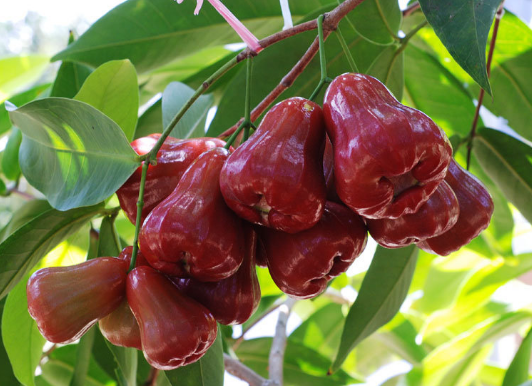
Water guava fruit with the name Dhegus - "The beauty of the guava is Degus, short for Gede(big) and Bagus(nice), as the name implies the appearance of the guava fruit is quite large with an attractive dark red fruit skin color, sweet and crispy flavor coupled with thick fruit flesh and a tambourized fruit shape similar to , an appearance that has a beautiful impression is the advantage of the beautiful Guava Degus. "

Degus guava is the name given by Mr. Ir. Soedarmo, former Bojonegoro District Agricultural Extension, and he was known by the nickname Mbah Darmo because he was a senior Agricultural Extension in East Java, most recently as East Java Agriculture Extension Coordinator. He was the first to spread this guava plant in East Java, including several locations around the Pohjentrek Pasuruan Seed Horticultural Motherhouse, which was then one of those planted at the Horticulture BBI was selected as the Mother Tree and was released by the Minister of Agriculture in 2006 with Decree No .339 / KPTS / SR.120 / 5/2006.

Water guava fruit with the name Dhegus | Indonesian Fruits


Water guava fruit with the name Dhegus  Indonesian Fruits

Degus guava can grow anywhere, from the lowlands to an altitude of 1000 m above sea level, but ideally to be able to produce optimally should be planted in low land with a height of not more than 400 m above sea level. With low rainfall of 500-1000 mm / year with a number of rainy days of 50-70 days / year or dry areas with a dry season of more than 4 months.

This juice can be cultivated either in pots or called Tabulapot, planted in the yard or tabulakar and also on a large scale which requires a special area for business success, for this reason it is necessary to consider the nature and conditions of growth and infrastructure available in the planting location.

1. Propagation of seeds / seeds

Propagation of degus water guava can be done by grafting, connecting, grafting and seeding. The choice of propagation method is adjusted to the requirements, the time conditions for the costs and the available technical personnel. Seed propagation is quite successful and the most appropriate is by grafting and grafting from the parent tree. For seed multiplication, it is produced by seed producers who have been registered at the Seed Certification and Monitoring Center (BPSB) with labeled seed production.

2. Planting

The spacing of the planting of degus water guava planted in the garden widely, the spacing between trees is at least 5 x 5 m. With this spacing, then in 1 hectare it takes 400 seeds plus 10% as a substitute for seeds that may not grow or die.

- Preparation of planting holes

Planting holes should be prepared as much as possible 2 weeks before planting. The hole is made by means of the soil excavated with a size of 60x60x60 cm. The upper part of the soil (30 cm thick) is separated from the bottom soil, within 2 weeks, the hole is left to the sun.

- Planting

When planting seeds. holes filled with sand 2/6 parts, 3/6 parts filled with fertile soil / top soil excavation after clearing of grass seeds, then the seeds are planted after the plastic packaging has been removed, the top layer is given manure as a basic fertilizer 1/6 parts (+ 10 kg).

3. Maintenance

- Sprinkling

If there is no rain for 2 weeks after planting it needs to be watered twice a day, the rest is only once a day. After the plants grow, watering is no longer needed because the roots of the plants have penetrated the soil far enough to get enough water even though the surface of the soil seems dry, on the contrary to avoid excess water, during the rainy season, plants need to be drained around it.

- Weeding

Weeding is done with the aim of removing bully plants (weeds), wild grasses and vines that often grow around plants can interfere with growth, especially when the plants are still small, aged 1- 3 years. When cleaning weeds, it can also be done weeding around the plants at least twice a year weeding and roasting.

- Advanced Fertilizer Giving

Fertilization is the right choice so that the degus water guava plant can produce better. Provision of artificial fertilizer is carried out twice a year and manure is given once a year, before the dry season of the dry season. Fertilizer dosage is adjusted to the age of the plant.

- Stitching

Seedlings that do not grow or die must be immediately refined, namely replacing dead seeds with new ones. Late embroidering will make plants grow not as big.

- Trimming

Maintenance pruning is done on branches, branches and twigs that are dry, dead, wounded, old, broken, and other parts of plants that are not perfectly growth. Pruning is also done on branches that overlap, growing irregularly so that the main branch is defeated. Branches that are sick or old but still productive enough are not cut out, but are left about 5 cm from the base. Crops that are too dense are also trimmed to avoid fungus coming.

4. Pest Control Disease

From the inventory of pests and diseases that attack degus water guava, there are several types of attacks that need attention. Symptoms of attack from each type are as follows:

Atlas moth (Attacus atlas)

The caterpillars are very greedy for eating leaves. Control by collecting eggs, caterpillars and cocoons to be destroyed and spray contact insecticides.

- Soft green scale (Coccus viridis (Green))

Causes of black fungus such as soot. Control of natural ways is eaten by several kinds of ladybugs. These fleas in the rainy season can be destroyed by fungus attacks, chemical control using contact insecticides.

- Bactrocera (Bactrocera sp.)

The genus name is derived from Ancient Greek bakter "rod" and kera "horn". This fly puts the eggs in the flesh, so after hatching the larvae eat the degus guava fruit. The use of Methyl eugenol and hydrolizate protein combined with insecticides.

- Root and Fruit Fungus

The rot in the root is caused by water flooding that is too long, causing rotting to the roots. The rot on this fruit is due to pest bite so that the fungus causes the fruit to fall out and rot. Control by improving soil aeration and fruit wrapping, as well as spraying insecticides and fungicides such as thiodan and dithane.

Cultivation of Dhegus guava can also be done by:


Water guava fruit with the name Dhegus  Indonesian Fruits

1. Cultivation of fruit plants in pots

Cultivation of fruit plants in pots or more popularly called tabulapot is basically planting fruit trees using pot plant media. The stages that need to be known:

  • Bibit is taken from the polybag packaging / media carefully so as not to damage the roots, so that the plants do not die.
  • Bibits are placed in the center of the hole as deep as the root neck. If you plant too much, the body will be less good.
  • Before being planted, the leaves are cut in half to reduce evaporation of water because the roots cannot absorb enough water from the soil.


Certain recipes to optimize the guava juice of Degus water include:
  • A suitable and optimal pot size used is usually 30-70 cm in diameter with a height of 40-50 cm.
  • Media planting a mixture of soil, sand, and manure 1: 1: 1 ratio.
  • First fertilization 1: 4: 2 Urea, SP36, and NPK 50 gr perpot at 2-3 months old, repeated every 3 months.
  • Flowering stimulation using ZPT such as Atonik.


Tabulapot guava, Degus water, besides being able to provide vitamins or fruit for the family, this tabulapot also has more value on its figure, red fruit clustered together with ornamental plants in the yard will look beautiful to look at.

Water guava fruit with the name Dhegus  Indonesian Fruits

2. Cultivation of fruit plants in the yard

In principle, the cultivation of fruit plants in the yard is the same as the treatment and technical planting, but there are certain things to note, namely:

  • The location or location of planting must be considered.
  • Lighting continuity is not interrupted.
  • Not disturbing or covering the building nearby.
  • Plant maintenance is expected to need consistent attention, do not let the plants become shrubs once.
  • Fertilization is done by using manure and artificial fertilizers such as urea, TSP, KCL. Every year the dose is added.

Water guava fruit with the name Dhegus  Indonesian Fruits

The method of planting in this yard does require a small yard which is eligible for shrubs. The production of guava Degus in this yard is more than the tabulapot. This is indeed expected for the needs of family fruits, as well as additional income when sold.


source:
bbppketindan.bppsdmp.pertanian.go.id

Sunday, August 19, 2018

Types of Bidara Fruit

Types of Bidara Fruit - There have been many articles that have written about this one plant both in print and electronic media, but it could be that not many people are interested in getting to know this extraordinary plant. Well, this paper will make the reader very curious and interested in getting to know and use this plant more. Bidara, or in Arabic known as this sidr, is a plant originating from Arabia, a small, always green, fruit-producing plant that grows in the tropics and West Asia and can grow in valleys up to a height of 500 m above sea level.

Types of Bidara Fruit


Description Upas
Bidara
Sea
Bidara
Chinese
Bidara
Putsa /
Indian Apple
Arabian
Bidara (Sidr)
Kingdom Plantae Plantae Plantae Plantae Plantae
Division Eudikotil Magnoliophyta Magnoliophyta Magnoliophyta Magnoliophyta
Class Asteridae Magnoliopsida Magnoliopsida Magnoliopsida Magnoliopsida
Order Solanales Rosales Rosales Rosales Rosales
Family Convolvulaceae Rhamnaceae Rhamnaceae Rhamnaceae Rhamnaceae
Genus Merremia Ziziphus Ziziphus Pyrus Ziziphus
Species M. mammosa Z. mauritiana Ziziphus Pyrus malus L. Z. spina christi
Binomial
name
Merremia
mammosa
Hall F.
Z. mauritiana Z. ziziphus Pyrus malus L. Ziziphus
spina-christi
(L). Desf.

Bidara trees when viewed from the place of origin there are 3 types: namely sea bidara, Chinese bidara and Sidr / bidara from the Arab region. I will explain this one by one briefly.

Upas bidara

Types of Bidara Fruit - Bidara upas is a plant that can split 3-6 m. The leaves are oval in shape, with a base of heart shape. The umbrellas are like potatoes, and different from the areuy carayun (Merremia peltata) which is one genus with it. Upas bulbs gather up to 6-7 fruits and can weigh up to 5 kg or more like growing on dry, loose soil and not inundated. The color of the tuber skin is brownish yellow, the skin is gummy white, when it is dry the color becomes brown.

Types of Bidara Fruit
Otaheite Gooseberry | Cermai Benefits For Better Life

The inflorescences are compound, that is, 1-4 flowers, umbrella shape, light white, and the eyes become fruit, the petals do not fall. The seeds are gray to black, with brownish hair edges.

The conclusion that I took that this bidara upas is not a bidara tree which is mentioned in the Al-Quran AL WAAQI'AH verse 28: is among the thorny bidara trees. Even the Upas bidara cannot be called a tree because the trunk is propagating, only the name is the same.

Marine bidara

Types of Bidara Fruit - Marine bidara (Ziziphus mauritiana) is a fruit-producing tree that grows on the coast or on the seafront.

Types of Bidara Fruit
Cempedak | Benefits For Better Life

This sea lion fruit tastes sour and yellow fruit color even though it is old, and the tree is thorny, but its thorns are bigger than the thorns of thorny trees from the Arab region.

Chinese bidara

Types of Bidara Fruit - Chinese bidara, magnoliopsid genus zizyphus or additionally referred to as shrub (from Greek ζίζυφον, zizyfon), ordinarily referred to as jujube (sometimes jujuba), red dates, Chinese dates, Korean dates, or Indian dates square measure magnoliopsid genus or bidara species within the Rhamnaceae ( Rhamnaceae), as a shady tree that additionally produces fruit.

Types of Bidara Fruit
Watermelon Smoothie - Healthy body and Delicate Face With Black Flecks Free Watermelon

Chinese bidara is a small tree or shrub with a height of 5-10 meters (16-33 feet), usually with spiny branches. Leaves are shiny green, ovoid-acute, 2-7 cm (0.79-2.8 in) and wide 1-3 cm (0.39-1.2 in) wide, with three striking veins at the base, and margins smooth jagged. The flowers are small, 5 millimeters (0.20 inches), with five striking yellowish green petals. This fruit is an oval with seeds that can be eaten, mixing adults is smooth-green, with consistency and taste of apples, the color of fruits that are ripe to purplish and finally wrinkled, look like small dates. There is one seed and is hard similar to seeds.

Putsa / Indian Apple

Types of Bidara Fruit - Putsa or Indian apple verse See the botanical name that originated from wikipedia actually does not belong to the type of bidara, but entered in the type of pear, but when viewed from the shape of the leaves and seeds hard I am sure this is still one type of bidara and there are similarities with Chinese bidara. This putsa tree is as big as an apple and sweet bread without sour taste, and the tree is not spiny.

Types of Bidara Fruit

Arabian bidara (Sidr)

Types of Bidara Fruit - A bidara from the Arab country (ziziphus spina christi) or known as Christ's Thorn Jujube ("Christ's thorn crown"), is a kind of small, ever-green tree, a fruit producer that grows in the Tropics and West Asia. Grows in Israel in valleys up to 500 m.

Ziziphus spina-christi has important significance for Jews, Christians and Muslims. According to a number of traditions, there is a tree producing thorny branches that are woven into "crown of thorns" and placed on the head of Jesus Christ before His crucifixion.

Types of Bidara Fruit
What is Bidara Fruit

The ripe fruit can be eaten and the flowers become important in honey in Eritrea and Yemen. This Bidara leaf is commonly used to carry out sunnah. This type of bidara leaves are sought after for the purposes of Sunnah, Ruqyah, and magic treatment.

The bidara fruit used to ward off magic / jinni in the process of rukyah and other purposes such as the prophet's sunnah is Arabic Bidara (Ziziphus spina-christi), because He (the Prophet Muhammad) used this bidara in the areas of Mecca and Medina.

This type of Bidara Sidr is very much sought after for the purposes of sunnah and magic disturbances. This type of bidara is what we sell for the treatment of magic disorders and others according to the recommendations of the Prophet Muhammad.

For other bidara leaves, I do not know for sure what can be used for sunnah purposes or not, so I will use I personally use this bidara leaf, because at that time the Prophet Muhammad used the lote leaves in the area of ​​Mecca and Medina. Wallahu A'alam answered.

source:
wikipedia
bbppketindan.bppsdmp.pertanian.go.id