|
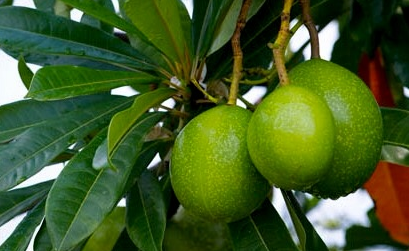
| Kepel fruit flowers |
Benefits and Content of Kepel Fruit (Stelechocarpus burahol) - Kepel plants are plants with stature that can reach 25 m. Kepel plants are native to Indonesia and are spread from Southeast Asia to the Solomon Islands, widely found in Java and Peninsular Malaysia. This plant grows wild in the forest and places throughout Java at an altitude of up to 150-600 m above sea level. In general, kepel grows well on fertile soil, contains a lot of humus, and has relatively high humidity. Kepel is a member of the Annonaceae tribe or a family of recitation and has various names in Indonesia. In Central Java and Yogyakarta kepel is also known as a simple or kecindul name, because the size of the fruit is as big as an adult's fist, the Javanese call it kepel. Symbolizes mental and mental and physical integrity such as clenched hands.
This kepel plant is a flora of identity and symbol of the strength of the Sultanate of Yogyakarta. At that time, kepel plants could only be planted in the Sultanate of Yogyakarta. Kepel fruit is popular princesses of the palaces and is believed to cause scented sweat and create excrement scentless. Ordinary people do not allow this plant, except a few abda dalem palace. In the colonial era, believers were only strong people who were physically and mentally capable of accommodating the royal family's lifestyle. Belief at that time was only an official of the proper level of dukuh and was strong in the heart of the royal family.
 |
| this is the appearance of kepel fruit if after splitting |
In West Java, Kepel was called Burahol, until two international taxonomists targeting the plant gave the Latin name Stelechocarpus burahol. This Sundanese Burahol is the same type as the Javanese kepel, the tree also grows in the forest, but the wives of Raja Sumedang, Galuh, and Dipati Ukur are not interested in the tree. The people of West Java consider the fruit not valuable, because the meat is not much. EYES, the large seeds are MENU. No one cares about the burahol tree from the forest being cut down, every time a part of the forest is opened to allow new settlements.
Potential Ornamental Tree
 |
| Fruit similar to Kepel fruit in Yogyakarta |
Kepel trees are quite beautiful, with perpendicular stems, and conical canopy. The crown regularly forms a pointed dome upwards (like fir) with horizontal or horizontal branching. The diameter of the light rod reaches 40cm, dark gray to black, which is processed by many large lumps. The leaves are oval to round eggs / lanceolate shape, dark green, hairless, horizontally; the leaf stalk reaches 1.5 cm in length. The flowers are first green then turn into whitish, appear on protrusions on the trunk or chatter. The fruit is buni fruit-type (berrylike ripe carpels), the ripe fruit is almost round, brown in color. If the fruit is finished, then the new young leaves are grown, the tree is even more vibrant, because the green of the old leaves is decorated with the red color of young leaves like cinnamon leaves. The leaves will be more shiny when exposed to sunlight.
Burahol Chemical Content (Kepel)
Fruit flesh, seeds and roots of kepel contain saponins, flavonoids and polyphenols, in addition the seeds also contain alkaloids, and the leaves contain flavonoids and polyphenols.
Benefits of Fruit and Kepel Leaves
Kepel meat, seeds and roots contain anti-bacterial, saponin, flavonoida and polyphenols, terpenes, and quercetin, accompanied by high levels of vitamin C and A, and the leaves contain flavonoids and polyphenols. In research developed by the IPB Research Center and enumerated in the Scientific Repository of the Bogor Agricultural Institute, several benefits were explained, including:
- Has function as hepaprotektif : Hepaprotective or protection of liver function in kepel meat. From the results of this study found the ability to restore the performance of enzyme production in the liver and help to regenerate cells from damaged liver.
- Affects sweat production systems and enzymes that trigger body odor : Basically the natural scent of the body is caused by two factors, pheromones that carry natural scents and mercaptan which carry a less pleasant aroma. Kepel fruit will work to control mercaptan production. In addition to kepel meat, there is a strong anti-bacterial agent against the formation of ammonia which comes from the reaction of sweat and bacteria and fungi.
- Helps smooth urine and shed deposits in the kidneys : Flavonoids are complete with high levels of alkaloids, phenolics, and quercetin. Antioxidants are proven not to interfere with kidney function, but instead help accelerate the process of cell regeneration in the kidneys and inhibit kidney cell damage. In addition, in the kepel fruit also found a diuretic ability that will encourage more urine.
- As a gout medicine : The high alkaloid content is effective in overcoming gout which is the cause of joint pain and damage. Alkaloids will dissolve in the blood and neutralize pH levels in the joint area quickly.
- As an anti-cancer : In kepel meat also found acetogenin, styryl lactons, and isoflavones which will work as an anti-cancer. Acetogenin is a unique compound that works to inhibit mitochondrial permeability from cancer cells and controls apoptosis of cancer cells. Styryl lactons have a role to increase tumor suppressor gene, while isoflavones will work to control estrogenic properties of cancer cells.
- Speeds up the cell regeneration process : The content of vitamin E, terpenes, and quercetin in kepel fruit make the emergence of the benefits of kepel to the function of cell regeneration and DNA purification. That is why in the past Princess Keraton often consumed kepel fruit to help overcome acne while eliminating acne scars. This cell regeneration properties will also help maintain body fitness and keep a person young.
- Prevents inflammation of the kidneys and causes infertility : The flesh is orange and contains the juice gives a rose-like aroma mixed with sapodilla fruit on the body's excretion (such as urine, sweat and breath). In medicine, the flesh serves as a urine laxative, prevents kidney inflammation and causes infertility (temporary) in women.
- Natural body fragrances : Sweet and fragrant kepel fruit. This fruit is a natural deodorant of the daughters of the Mataram Palace in ancient times. Sweat princesses who eat the fruit will smell good after eating this fruit. Her urine will also smell nice. Breath will be fragrant. The habits of the Mataram daughters were then imitated by other palaces in Java.
- Make the skin clean : This high dose of vitamin C, makes the skin clean. From inside the body the content of kepel fruit cleanses the blood, strengthens the liver, lungs and kidneys. Circulation becomes smoother because the frozen blood becomes liquid.
- For pregnant women is believed to give birth to a beautiful baby : Vitamin C content in kepel is very high. Pregnant women who eat kepel are believed to give birth to beautiful babies. Baby's skin will look clean.
 |
| so many pieces of Kepel fruit while still in the tree |
Many of the benefits that we can take from kepel apart from being fresh fruit are also alternatives as herbs that greatly help overcome some diseases. This rare plant can still be found in Yogyakarta Palace, Bogor Botanical Garden and Mekarsasi Fruit Park. With so many benefits and currently still rare fruits in Indonesia, of course it has a great opportunity to be cultivated.